

Forum Replies Created
-
AuthorPosts
-
Kenny Klimes
KeymasterMike,
Thanks for the Info!!
We will get down soon and fish with you – that’s a promise!
KeymasterOne other technique is to attach a small weight to the end of your leader and hang it up by the butt end. Allow the weight to stretch and straighten your leader. Have never tried this but if “heat” helps straighten a leader try using a hair dryer on the line while it is hanging with the weight. I wouldn’t get the line too hot. After you try it let me know how it turned out.
KeymasterTony-Mac
I see you found the Flyfishers at the Crossing (FATC). Please send us an email at [email protected] and we will send you information on how to become a member in our fellowship. Also, check out all on our website – we do fish a lot but also do community service, charity work and of course, we stress brotherhood. We would love to have you join us in our adventures.
KennyKeymasterTim, hit it on the head. Heat probably is the biggest destroyer of tippet (actually any mono line – i.e. includes leaders too). If tippet is kept out of the sun or heat it can last a long time. The “fresh” tippet idea isn’t as true as some fly fishers believe. But if you don’t fish a lot then get the smaller spools of tippet not the guide size. If your tippet seems to break too often then check your knots, that’s probably the culprit more than the tippet being old. Remember always, always wet or spit on your knots before tightening them. They should slide tight.
Almost forgot – 7x tippet??? be very careful on hook set. 😉
-
This reply was modified 6 years, 12 months ago by
Kenny Klimes.
KeymasterBeen tying down to 24s and that’s it. They want something smaller “let them eat cake!!!”
Important thing is DON’T CROWD THE EYE!! (and use magnifying glasses). If you don’t crowd the eye they are easier to tie on to the tippet.
KeymasterBK
Just returned from Lake Taneycomo trip #1. Even with the generators off they still had flow on Taneycomo as they opened up two flood gates to release water. We were able to wade fish but the flow was fast at around 3500cfs and a lake elevation of 706 ft. And yes, two days after the generator shutdown and the spillways opened, we did see lots of dead shad along the shoreline. Interesting to see if that will “fatten” up the fish at all. We tried white shad looking patterns but no takers.
KeymasterI don’t have a dog AND I don’t have any hair. OK, it could have been my back hair – YUCK!!
Thanks for the compliments – it was a fun night.
KeymasterThey could go to Florida but I doubt it. You never see dead trout laying around after a flood cause I think they know to swim and move with the rise and fall of the water. So with that said, in my opinion they spread out and then return to their “bomb shelter” or hiding place when the flood recedes. Obviously they could move to a new location after the flood has made new holes and new lies for them to use. I find the best tactic is to look at the “flooded” river after the flood recedes as a new river. The changes caused by the flood should be studied as if you have never fished that river before. Yes, the fish may be hiding in the same places but also may have found new lies that offer better protection, food and oxygen.
You need to renew your membership in the FATC – just a reminder.
Keymasterdvan…
Great question as there are many techniques that fly fishers use when fishing double flies. I have for years used the method you described where I have tied my second fly directly to the hook of the first fly. I find less tangles with this set up but since I have been using all barbless hooks there are times when the tippet tied to the bend of the first hook has slipped off and I have lost the second fly. Now this rarely happens but there are times if your line goes slack (and you shouldn’t let it) when catching a fish on the bottom or second fly the tippet can slip off.
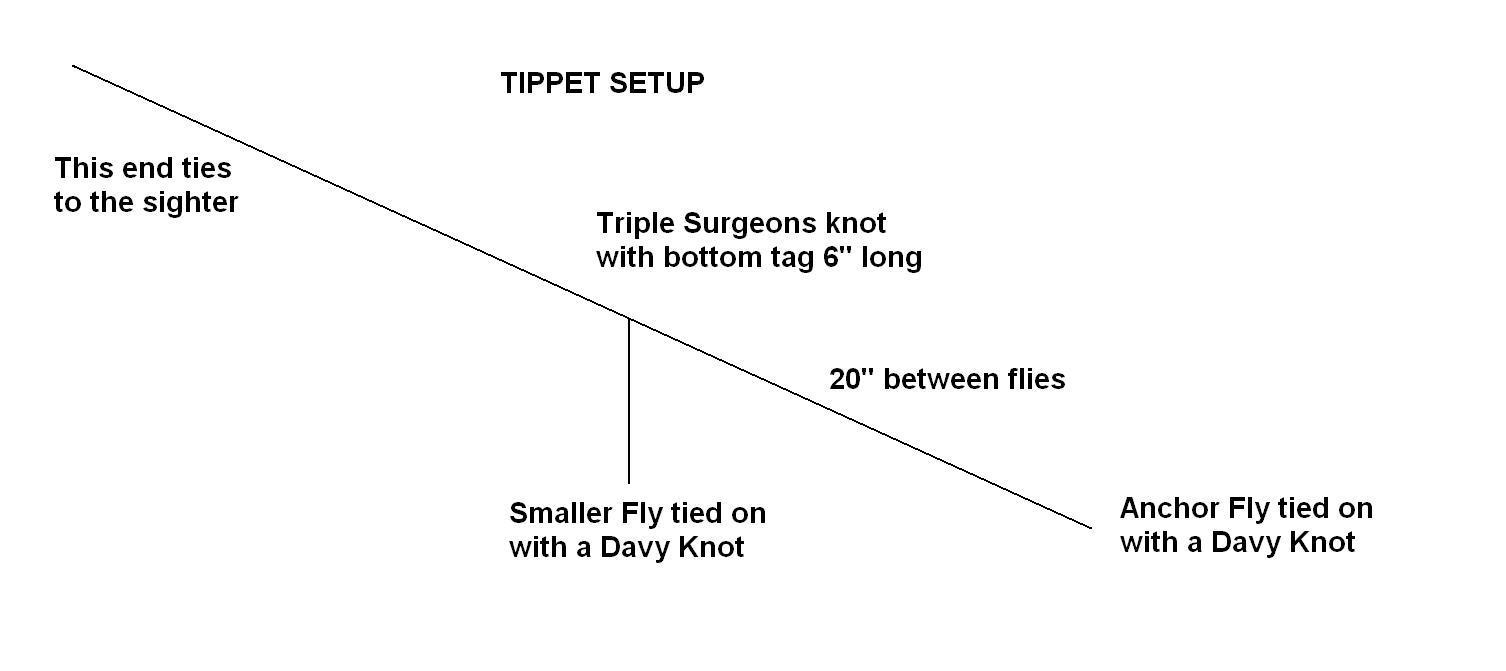
Since I have gotten into Euro Style Nymphing (ESN) I have used the tandem technique used by many of those fly fishers which is to tie the top or first fly to a 6-8 inch tag end section created by the top tippet running from your line. (as shown in the picture) This setup allows the top fly to swing freely in the current and the tippet doesn’t get in the way of a good hook set.
 Keymaster
Orange indicators – hatchery fish – OK.
Indicator colors and sizes will spook wild trout. I’ve seen it and learned my lesson.
Thingamabobbers with the “jam-stop” will not kink your line (run your line through the hole and use jam stop to lock it in position) but dropping the screw cap of an Air Lock indicator will kink your day.
Euro nymphing versus indicator nymphing does have drawbacks but Euro nymphing is very effective.
KeymasterEemmmmmm, could be????
KeymasterOh MO MO, you must be bored!! But then so am I so I’ll answer.
1. The general rule is 1 1/2 times the depth of the water. It will take time for your flies to sink (use weight commensurate with the depth and speed of the current). And with the indicator “pulling” your flies along they will probably never float directly under your indicator but always slightly behind – allowing the extra length of the leader to “not’ touch the bottom.
2. Great question. Yes, you should use specific types of indicators for specific conditions. As a general rule – smallest indicator possible for the situation. More weight then the larger the indicator – don’t allow your small indicator be pulled halfway or more under water by your weighted flies or split shot. It will lose it’s sensitivity to a strike. So, if you have to add more weight to get your flies down, i.e. deep water, fast current then you need a larger indicator. Clear, shallow water smaller indicator – yes, the indicator can spook the fish! Maybe a white New Zealand yarn indicator to look more like the “white foam” on the water or a clear thingamabob indicator to look like an air bubble from below the surface. DON’T Forget – dry flies can be very effective indicators too
3. White or clear
4. Dead drifting flies (not tight line nymphing – which is another topic) use an indicator to help you realize a strike. Flies without beadheads, two fly rig, flies with beadhead, etc… if not tight lining then I’d use an indicator to help detect the strike.
5. Fast moving waters and deep holes with heavy flies, I like the thingamabobber. The most sensitive indicator I’ll go with the New Zealand system for clear, slower water.
6. Yes, the number one tip when fishing indicators is SET THE HOOK!! When that indicator does ANYTHING different from it’s normal flow through the water surface – slows, stops, jiggles, – ANYTHING – then set the hook. Hook sets are free. I see too many guys miss fish because they expect the indicator to go under water. The trout takes in their fly and in seconds spits it out and the indicator continues on it’s way downstream…. and no fish.
KeymasterOne technique the podcast talked about on how to clean fly line was to use a Scotch Brite pad. I was shocked!! Wouldn’t that “scrap” the coating on the fly line? Apparently not. The microscopic coating for a fly line is throughout the coating so by “scratching” a microscopic layer away from the fly line it will make it as brand new. Wow, who would have thunk it?
Listen to the podcast to hear more about this “cleaning” technique!!
KeymasterHey Timmy! I like Buffalo Trace too!!
KeymasterYES, THAT’S EXACTLY HOW I FELT WHEN I GOT MY NEW H3.
AND DON’T TOUCH MY ROD!!!!!!
-
This reply was modified 6 years, 12 months ago by
-
AuthorPosts