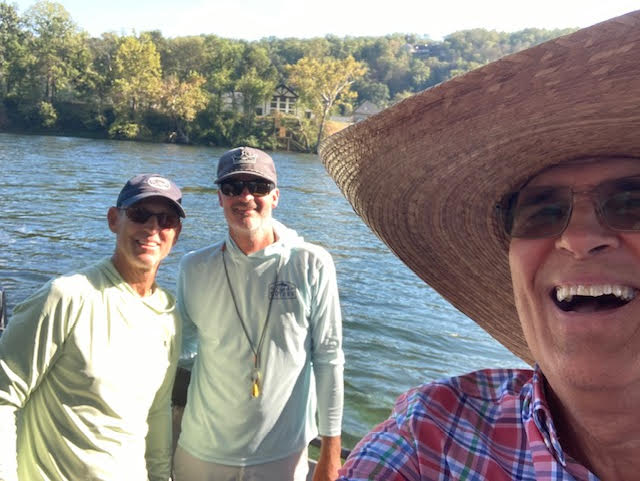
The White River in northern Arkansas enjoys quite a reputation among fly fishers nationwide. It is consistently ranked as a premier, world-class fishery and has often been the source of record trout catches in more than one species. Fall can be a great time to fish the tail waters of Bull Shoals Lake and nearby Norfolk Lake too. FATC member David Broeder and I, Al Harper, traveled down there the first week of October 2025 to try our luck.
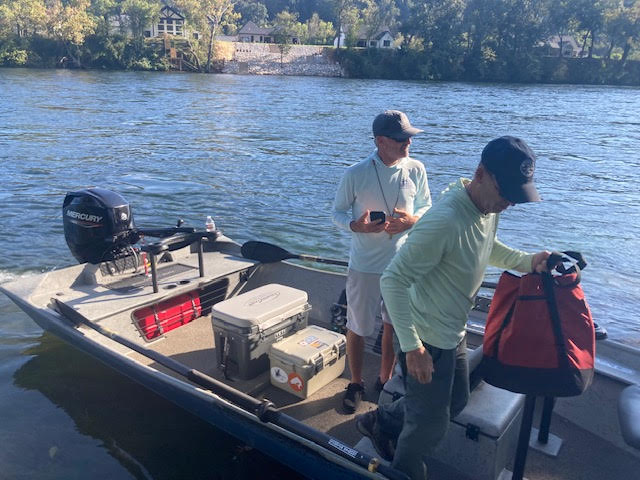
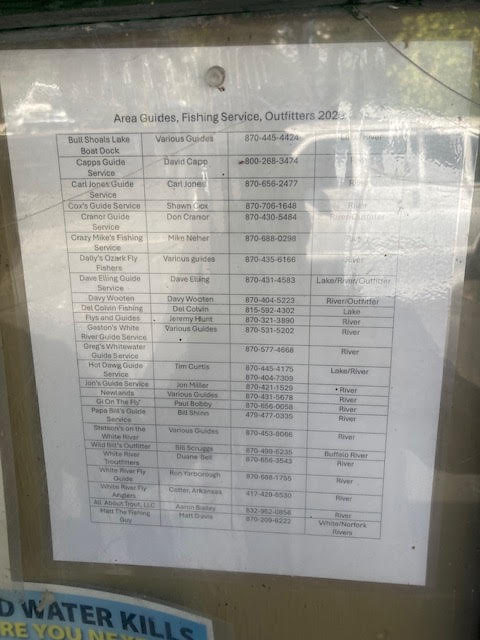
I’ve been fly fishing the White since around 2018, but this was David’s first excursion there. He wanted to catch a brown trout and I was hoping we could get some action on hoppers. I’d been in touch with another FATC member living in that area, Mike Enger, trying to gauge a likely time to find favorable conditions. It was a wet summer with a lot of water being released from the lakes. Water releases had eased for several days, but then, for reasons known only to management of the Corps of Engineers, we faced big water that precluded our plans to wade fish. We were, however, successful in making arrangements with a guide with a substantial drift boat that could handle the strong cfs conditions.
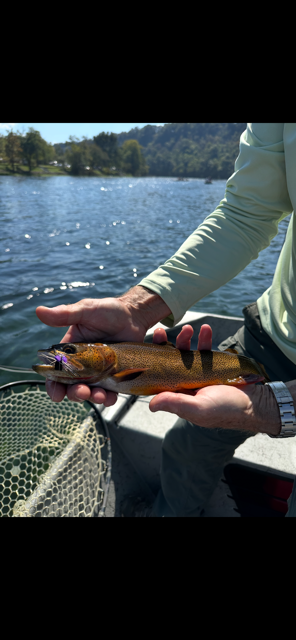
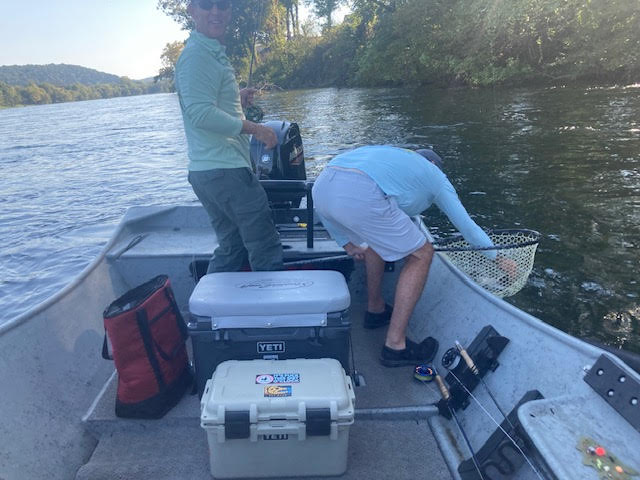
We launched on an almost crisp morning but temps would reach the mid to upper 80s later that day. We began by casting Pats Rubber Legs with midge droppers and soon picked up a few fish. David hooked a really nice brown that had mastered the art of throwing a hook so we only got a fleeting glimpse of his substantial buttery-colored side and his back. But more action (with a few more misses) were to follow. We soon got into the routine of line mending and setting the hook from our perch in a bobbing drift boat that had the hours drifting by too.
The technique employed by most on the White seemed to entail motoring upriver then careful drifting back down specific stretches. The person on the oars keeps the watercraft the desired distance from the shore. High fast water meant only a few anchored up and those doing so had to use care to ensure the river bottom was free of obstacles that might hang an anchor and lead to a potentially dangerous situation. With a minimal release, the mighty White can seem like a fairly tame, oversized creek with lots of places for wading.
In the early afternoon we began to search for trout that might respond to hoppers and we found some in a curious location. One usually casts along the shaded banks where grasshoppers might be in the water after falling from a tree branch or undulating long stalks of grasses. But instead, we got strikes out in the middle from trout holding over submerged islands visible because of their bright green vegetation.
But hooksets on those strikes proved devilishly hard to get. We landed a couple but others proved illusive. Our guide, a temporary transplant from Pennsylvania, made suggestions, of course, but as many anglers know, there are many factors at play with hopper fishing. One of the most important factors — assuming one has covered the basics of a sharp hook, a good drift and a leader with a minimal amount of stretch — is how aggressive the fish strikes.
David and I had enjoyed a successful day of fishing from my drift boat with poppers that yielded about 60 hungry bass back in May in Franklin County. So we knew a little something about this dry fly effort. But while trout in the middle of the White were willing to investigate the large hoppers we offered, I remain unconvinced of the seriousness of some of the strikes. Further evidence of their reticence is that interspersed with what would often appear to be some good strikes were boils where trout executed a last minute refusal.
Another factor was the distance from the boat required to get a strike. The more line on the water, the longer it takes to transfer that jolt of kinetic energy it takes to get the set. Nevertheless, after a couple of dry runs, we got better and David got another brown on a hopper. Our final efforts as the afternoon wore down, were a number of assaults way up to the very foot of Bull Shoals Dam itself. When completed in 1951, it was the fifth largest dam in the U.S. standing 256 feet above the river bed. It has been surpassed in size over the decades, but when you’re below that much concrete, it’s still pretty intimidating.
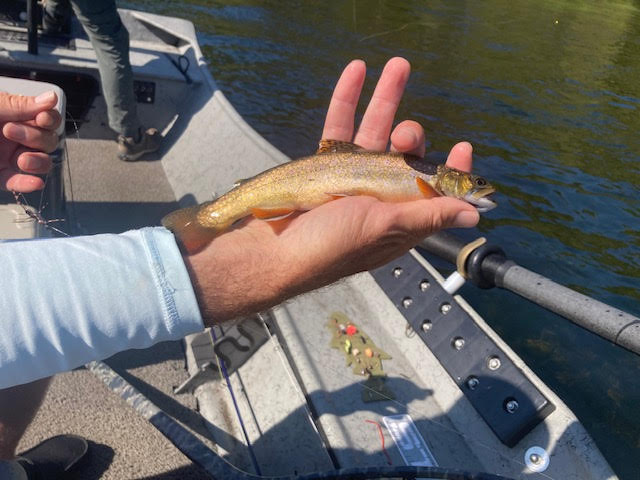
Fishing there brought a new challenge as it required about an 11’ leader under an indicator and a dropper rig finally at the end. It was a real bear to cast, but effective; yielding some good fish from the depths. After a few assaults, we rode the strong current far down river and finally called it a day. We had caught bows, browns, cutthroats and brook trout.
Still wanting to do some wade fishing, we decided to stop over at Spring River on the way home. Here David did exceptionally well with small nymphs. I believe he landed 8. I tried streamers, which had produced well in past trips, but a lack of deep water seemed to preclude that. I finally hooked a nice bow far out in a wide section of the river and got him almost within reach. One other small bow finally grabbed my egg fly. The Spring looked good, if a little low. We had Lasseter Access all to ourselves till we were leaving when one other angler showed with a one-man raft. Not a bad idea given the slippery bottom of that river.